Showing posts with label Arc Blast. Show all posts

Thursday, 4 June 2015

TGO Challenge 2015 - Gear Used and Abused

St Cyrus Beach, waving my absolutely brilliant Pacer Poles
I posted a kit list before setting out on the Challenge and so I thought I would write a few short comments about some of the gear I took with me. As you will see, I took a deliberate decision to carry quite a bit more weight than strictly necessary.  I still have mixed feelings about this, and constantly struggle to get the weight versus comfort balance right for me. Having written that, I did note ironically, as I bought a piece of unneeded but fancied cheese in the Co-op in Ballater to stick in my pack, that its extra weight entirely counteracted the saving in grams I made when I bought a lighter sleeping bag last year.  But then who wants to eat a sleeping bag half way up Mount Keen I want to know.

 The 'Big Three' (or Four or Five)

Many backpackers write about the 'big three' critical items of shelter, pack and sleeping bag when commenting on gear and weight carried.  I would also add footwear and rain gear.  To be comfortable you really need to get all these right.  So I took:

Tent - My Tarptent Scarp 1. As the weather forecast was for quite a lot of wind and rain and chilliness, I decided on the Scarp 1 rather than my considerably lighter Z Packs Duplex.  I am pretty confident that the latter would have done me just fine, but I have used and abused the Scarp far more, only having acquired the Duplex towards the end of last year.  I also thought the Scarp would be warmer, given its double skin and lack of mesh, which helps cut down on draughts.  As expected, the Scarp performed superbly.  Rock steady in the squally wind, plenty of space with its two vestibules, allowing cooking undercover and storage of wet gear.  If this tent was half a kg lighter I'd never want to use anything else.
My Scarp 1 in quite strong, squally winds in the lee of Dalbeg Bothy
Pack - the ULA Catalyst.  As with my shelter, I opted for my long used, and so well tried, ULA Catalyst, rather than my Z Packs Arc Blast.  This choice was entirely dictated by taking the Scarp. The Catalyst has a massive external mesh pocket which swallows the Scarp far more easily than the Arc Blast.  It has lots of space, meaning packing up, especially in the wet, doesn't require much care or thought, and is superbly comfortable to carry.  If I had taken the Duplex I would definitely have taken the Arc Blast which is also a great pack, and is about 900 gr lighter than the Catalyst.  I am likely to use the Duplex and Blast combination on all my shorter trips.
ULA Catalyst on St Cyrus Beach
Sleeping Bag - A Z Packs 20 Degree bag (long and extra wide).  I think this is a great sleeping bag.  I sleep very cold, and so if the temperature is going to get anywhere near freezing I also wear my PHD down jacket to bed, which has a hood.  I was only chilly on one night in this set up, unlike in previous years when I used a Rab Neutrino 400 - which I found less warm but quite a lot heavier.  The Z Packs bag has to be one of the lightest on the market in terms of the amount of down / temperature rating.  Having said this, I met one other Challenger who had bought and sold a similar Z Packs bag as he didn't like it for a variety of reasons.  Individual preferences.  Oh, and one of my best investments in recent years was the purchase of down socks from As Toucas, which really make a substantial difference to warmth at night and in the tent in the evening.

Trail Shoes - I wear these more and more rather than boots, and think they are brilliant for the Challenge, especially so in avoiding faffing about at river crossings.  You just plunge straight in.  Despite the occasional snow patches, my feet generally kept warm and after about five minutes you do not notice that they are wet most of the time. I wore the same pair as last year, the 'new' style Inov8 Terroc 330s. 'New' style, but no longer made unfortunately. They were faultless, but having done two Challenges now, plus many day walks, they have been relegated to dog walking since I got home as the uppers have worn through in places.  I have no idea what I will replace them with yet.  As for socks.  I am a real fan of X Socks Exped socks which I find incredibly comfortable, and as in previous years I did not get any blisters, even after some fairly pro-longed road trudges.  Rinsing them in a stream each night keeps them relatively fresh.

Waterproofs - I wore a Berghaus Paclite jacket.  And I wore it a great deal because of the weather we experienced.  Paclite is much maligned.  I have been very happy with it, but this item is now about 6 years old, and it has seen its day.  As for overtrousers, I wear Berghaus Paclites, too, and these really are the dog's doo dahs.  I don't reckon there is anything that would better suit my needs, and they do appear to be the commonest type worn by fellow Challengers.  Mine have now provided me with great service for several years.  I have often worn them all day, and find them comfortable and condensation free.


Other Stuff - Most of the things that I carried were used, except for many First Aid items and my repair kit.  I may lighten these for the future, dispensing with some wound dressings and some of the spare dyneema and bungee cord, but this will only save a few grams. I consciously chose to carry other things which I knew would increase weight, and could be dispensed with, but thought they would add to my overall comfort.  Thus, I had the luxury of spare trousers - the incredibly light Rohan Ethers, which I highly recommend if you, too, want to carry a spare pair on trips. They only weigh about 220 gr. I also took the light weight Hi Tec Zuuk shoes for wear in B and Bs and when eating out.  They do the job.  In terms of other clothes I suppose you do not need to carry a spare shirt, socks or pants but it is nicer when you are in town in the evening if you do, and I particularly like my new Rohan Zipped Silver Core base layer which served as my spare.  On the subject of Rohan gear, I walked every single day in my zipped, long sleeved Rohan merino base layer shirt.  I also slept in it every night.  I washed it after Days 6 and Day 9 and to my refined nose it never became offensive!  It is is one of the best bits of basic kit I own.  I wore, and needed, all my cold weather clothing, including lightweight fleece, Montane Prism gillet and Prism gloves, PHD Minimus Down Jacket, fleece beenie and buff.

As is the case almost every time I go out in the hill I used a pair of Pacer Poles which I think can not be beaten, although I wish they would make a model with flick lock closures.

I had one piece of equipment failure.  This was an almost new Piezo ignition sparker thing that came with my MSR Micro Rocket stove which I purchased this spring as the pot holders on my old Optimus gas stove became rather bent.  It packed up after three days.  Fortunately, I carry a spare lighter.  I also had a dodgy self-sealing gas cartridge which didn't self-seal very well, and gave me a couple of anxious moments.  I am, partly as a result of this, thinking of taking my Trail Designs Ti Tri meths / esbit set up in future, rather than gas.

That's enough about gear.  I bought the lot with my own money, of course, so the comments here are not influenced by any of it being free.  Unfortunately!!!!

Saturday, 4 October 2014

Friends Old and New: An overnight trip in the Shropshire Hills

The hills of South Shropshire are where, over half a life time ago, I first broke in my walking boots.  Living in Shrewsbury as a teenager, with my best friend in Church Stretton, I spent many, many weekends walking these hills, both day and night, for we not infrequently walked from before it was light until after dark, and on a number of occasions walked all through the night.  In one twenty hour walk, in October 1974 I think it was, I covered fifty miles across these hills, and this remains my record to this day.

Looking up Carding Mill Valley
The other day I was very keen to get out in what was forecast to be the last of our 'Indian Summer', but nervous of a still tender back after a fortnight of some discomfort. The prospect of a trip with good weather, and the chance to try out a new shelter overcame the wise voice in my head telling me to rest up a few days longer.  The compromise was adjusting my original plan of a high camp at a nice spot I have in mind on the top of one of the Berwyns in favour of a favourite short walk, followed by a camp near a village with a pub.  This would save me from twelve hours lying in a dark tent on a Neoair, not the best treatment for lower back pain.

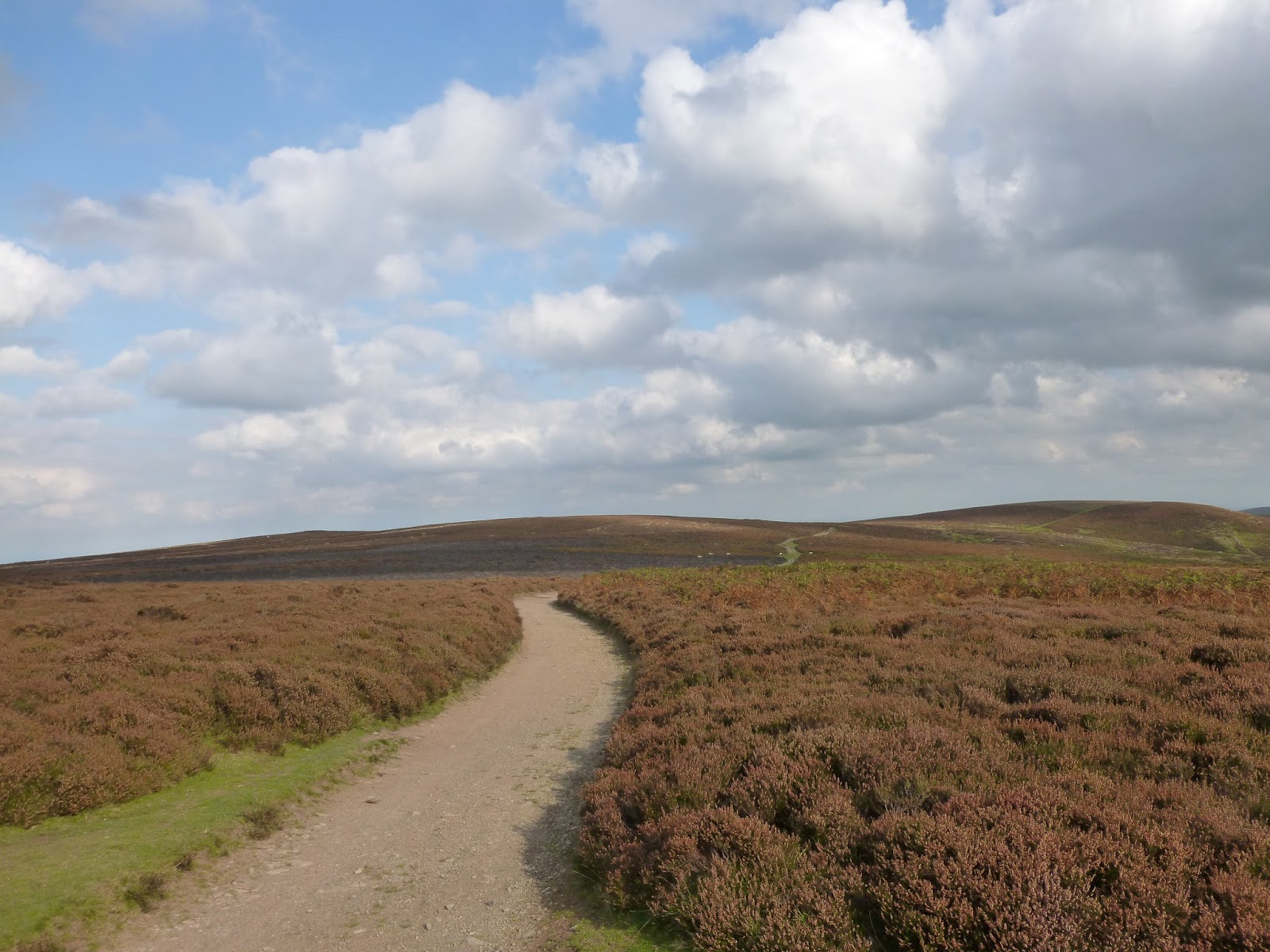
Thus, I headed in the early afternoon to Church Stretton with a pretty light overnight pack by my standards, and set off up the Long Mynd.  For those of you who have never visited, this is delightful, but easy, hill walking country. The Mynd itself is a long heather covered moorland plateau running north to south.  Its east side, facing the Stretton Valley, is disected by several deep, parallel valleys, of the classic geography text book V shape.  Locally, these are often known as a batch or a hollow. Between the valleys are very broad ridges.  Thus, it is easy to combine circular routes to the top of the Long Mynd, Pole Bank, via a couple of valleys or ridges or one of each.  The top is at a modest 516 metres, but on a clear day it has glorious views as far as Cadair Idris and the Rhinogs to the west, and the Urals to the east. Yes the Urals. Honest! See my earlier blog post.

Looking back down from near top of Carding Mill Valley to Church Stretton
Thus, I headed along a cunning path that runs well above the parked cars in the lowest reaches of the honey pot which is Carding Mill Valley, then up that valley itself, passing the school fieldwork parties that always come here, each struggling after such a dry spell to undertake a stream study. The path is a lovely gradient, steep enough for you to get a sweat on and increase the pace of your breathing, but just when you feel you might want to stop for five you emerge on the plateau of the Mynd where you can stretch your legs and stride out for miles in this super walking country.
The Portway - a pre-historic track across the top of the Long Mynd
From the site of the old corrugated iron shooting box, which must have been gone for twenty or more years now, there were impressive views westwards on this lovely clear day. A couple of miles to the west is the lovely Stiperstones ridge, with its tors that make the Devil's Chair, and its unmissable sky line, and its ankle breaking quartz rock hidden in the heather that runs the length of its ridge. Further to the south and west is the easily recognised profile of Corndon Hill, still in Shropshire, but right up to the Welsh Border with old Montgomeryshire, killed off in 1974, resurrecting the Powys of old, but without its princes. And on the far horizon, the distinctive shape of Cader Idris, which must be forty miles as the crow flies, and the high mountains of southern Snowdonia.

Pole Bank - the top of the Long Mynd, looking towards the Stiperstones

Selfie at Pole Bank

From Pole Bank I back tracked a couple of hundred yards and then headed off down towards a spring called Boiling Well and the lovely little path down Ashes Hollow, winding through the autumnal bracken, following the stream around its perfectly interlocking spurs.  

Heading down Ashes Hollow

In Ashes Hollow
Right at the end of the hollow is a small but perfectly formed little camp site on the edge of the village of Little Stretton. I last camped here with my little brother when I was sixteen, in my first ever tent, a Litchfield Mistral 1. This served me well in my early forays in the hills, until its groundsheet lost all its waterproof coating four years later resulting in a damp night in an Alpine meadow. That was the day after Elvis Presley died. My memory is a strange and mysterious thing.
Wonderful location at Little Stretton, but rather over priced
It was somewhat fitting that I was back at the site where I tested out my first tent, as I could now try out my latest, my Z Packs Hexamid DuplexAlan Sloman has decreed that all tents should have a name, and that tents are female, so the Duplex is now Daphne.  At just 835 grams, with added linelocks, pegs, and in the 'heavier' grade cuben fibre option, she is ultra lightweight for a two person shelter, and she has some pretty radical design features. But I need to know how she will handle bad weather.  Rain should be no problem, but what about a good British hoolie?  She  certainly wouldn't have managed well tonight, though. I tried out a new set of Vargo titanium pegs, and four of the six bent badly and so she was not anchored down that effectively. What titanium is doing bending so easily I do not know, but I shall bring the Clam Cleat Tornadoes next time.


I'm getting my money back. Vargo Titanium V pegs after their first use. The four failures all occurred at the same point on the peg
Before bed, though, I wanted to indulge in some fine dining.  Sainsbury's packet tomato soup is really rather good. Mountain House dehydrated meals aren't.  I am still using up a stock from an ill advised purchase.  Perhaps the walk had been too short to make it edible, but it was in the bin after a couple of spoonfulls, the perfect excuse to walk a few hundred yards to the Ragleth Inn and a very good bar snack. Tempura prawns in chilli sauce, Steak Dianne, sticky toffee pudding and a couple of pints of 'Shropshire Lass' if you want to know, and an hour with the Kindle, before heading back to the tent.

I wasn't to find out this night how well Daphne copes with weather.  For much of the time it was still, and only in the early hours did the slightest breeze materialise.  I bedded down with the doors open on one side, admiring the stars and the moonlight.  For a single skin shelter I was impressed at how little condensation formed.  It was a calm, clear night and I was next to a stream. There was some, but she is super spacious and it was easy to stay away from the walls. There is none of that head in the sides nonsense of many other lightweight shelters, either when lying down or sitting up.
Z Packs Groupie: The Hexamid Duplex, aka 'Daphne' and the Arc Blast aka 'Billy'

Daphne can take two men at once. She is a palace for one

I had to get back home earlyish in the morning, so after my breakfast special of porridge made in a plastic bag I had a back jarring couple of miles by road to Church Stretton and the car home.  A fine little outing for me and the new girl.

Saturday, 27 September 2014

Shiny New Stuff From Z packs

This post is not a gear review. You can not sensibly review products until you have tested the life out of them, by which time they are often off the market!  However, I have had a number of queries and comments via Twitter about some recent purchases, with some requests for photographs.  Thus, I will call what follows a "first look".  In any case I can't get my head around doing gear reviews. I normally end up being  facetious as in my Pimp my Rucksack blog post.  I'll try to be serious here. The products which I write about are both made by Z Packs in the USA.  As ever, and especially to irritate @Locomountaineer, there must be  a disclaimer.  I bought all this stuff with my own hard earned pension. I have no relationship with the company other than as a customer.

Firstly, about Z Packs. To be frank I had never heard of them until this May. Their founder, Joe Valesko, was on the TGO Challenge, and I heard a few people mention this. On my last day on the Challenge I was on top of the cliffs at St Cyrus and heard Joe shrieking as he waded semi-clothed into the cold North Sea with his two colleagues.  I also shared a bus with these guys to Montrose and was amazed at how small their packs were.  It made me think.  So I checked out their website, and thus began my purchases, funded partly through some active recent selling of a number of pieces of surplus gear on Outdoor Magic and E Bay.

There are four things I want to mention about this company.  Firstly, they make some incredibly lightweight gear, seem to specialise in cuben fibre, and the prices seem to compare well with other firms working in this same expensive material.  Secondly, much of their stuff is customisable, which is really useful if you are very tall/short/fat/thin/blue eyed or whatever. Thirdly, they appear to have an extremely good reputation with US backpackers.  I do a lot of googling before buying and it was hard to find anything negative about them or their products.  Finally, they are very customer focused, with great service and you can easily talk with (well e-mail) Joe himself in advance of your purchases to make sure you get the right product for your needs. I stress I have no personal incentive to be be so positive but they deserve this praise.  I want good companies to prosper so compliments should be given when they are earned.  This company knows how to deal with people, and they know their backpacking.

The Arc Blast Pack

I ordered a 60 litre pack with the following additions: two hip pockets, one shoulder strap pocket, walking pole and ice axe loops, and extra lumbar support.  It is made of cuben fibre but has an outer covering of polyester to add durability (several colours available).  With these additions, and the longer back (see below) mine weighs in at just 590 grams. That weight is pretty incredible.

The pack has a clever frame which you must put under tension before use by pulling tight the cord on 4 linelocks (see third photo below). This creates some air flow between your back and the pack.  When ordering I wanted a longer back than any of the advertised lengths. This was no problem, and was at no extra cost.  For me this was one of the most important reasons I chose this pack. The hip belt  sits properly on my hips.

The Z Packs Arc Blast, 60 litres - the pack closes very neatly and securely - I hadn't fastened it properly when I took this photo. Nor is the pack properly filled - I had just bunged a sleeping bag in it to fill it up a bit.


Rear view showing the added extras of additional lumbar padding, two hip pockets and one shoulder strap pocket

Close up of frame - the idea is you tighten the four line locks. The tension then curves the frame, creating a gap between frame and mesh to allow some airflow to your back

I have only used the pack for a few days, carrying a load of about 10.5kg including food and fuel. It was a very comfortable carry.  I found the system to tension the frame difficult until I realised that this is straightforward if you do it when the pack is empty. When full it is was problematic, needing a lot of effort, and the thin cord cut into my hands. Lesson learnt.  Clearly, I can not comment on durability but reviews from US hikers and comments from long distance backpacker Keith Foskett have not raised any concerns. The mesh outer does not appear that robust to me, but I haven't tested it. I think it will need to be treated with care. The hip pockets are of a good size, as is the shoulder strap pocket.  The two lower open side pockets are reasonable, but I'm not certain I could use these for my shelter - they may be a little narrow.  I would like one to have been wider and deeper. I wonder if that would have been possible if I had asked before purchase? I like the roll top closure.  It's similar to that system on other packs I've had (eg a Golite Pinnacle and ULA Catalyst) but also has a full length velcro fastening which seems to make it easier to close effectively and securely.  As I wrote above, I bought the 60 litres size (they also do a 45 litre and a 52 litre) and it doesn't feel a generous 60 litres, so if you are buying, and in doubt about the volume to choose,  I would size up. The additional weight for the larger size is miniscule.  On a very superficial note I love my choice of colour and the fact that the various add on pockets are also in this rather nice shade of green.

The thing I will come back to again and again, though, is the incredibly light weight for a 60 litre pack with a frame.

The Challenger Jacket

All I had originally intended to purchase from Z packs was a lightweight jacket, promised me by my wife as a birthday present.  Again, I couldn't quite get my head around the advertised weight of the Challenger Jacket which is 180 gr in the XL size.  That's about 350 gr lighter than my Goretex Berghaus Paclite jacket which is the lightest waterproof I had previously owned. You pick this thing up and it almost seems to float off into the heavens.  I quite bored my long suffering wife by handing it to her and saying "here, hold this, isn't it light?"  I had the additional pit zips to improve breathability.

The jacket is made of a hybrid E Vent / cuben fibre material with a thin outer layer of nylon which, the company says, makes it more durable and allows it to be given a solid black colour.  As you would expect from the weight it is minimalist in design.  It has one chest pocket - which is not big enough to take an OS map.  I really like the simple wrist and hem closures which seem very easy and effective to use. There is no storm flap on the zip, which is supposed to be waterproof. The hood is very comfortable, just the right size for me, and it has a slightly stiffened peak.  It can be rolled and fastened away. The whole jacket packs very small.  To my intense annoyance (!!!) it has hardly rained since the jacket has  arrived, so any comments about whether it is fit for its main purpose can not be given now. I have high hopes of it, and if it does breathe as well as claimed it will eliminate the need to carry a separate wind shirt, meaning an even greater weight saving.

The Z packs Challenger Rain Jacket - it is not as shiny as this photo makes it seem

The Challenger Jacket - showing the rather dapper mottled white inner

As one blogger has questioned the hood this photo is to show that it is more than adequate
Finally, one tip if you do order anything from Z Packs.  They sell a whole series of useful accessories, not easily available in the UK eg cuben fibre repair tape and patches, stick on mitten hooks, tiny linelocks etc. These are very cheap and so I got various bits and pieces added to my order as the costs of buying them separately would have been high given the minimum shippng costs.

Afternote (28/09/14): one reader in the comments asked for photos of where the hood volume adjuster is attached. Those that follow are for those who want this sort of detail!


Hood volume adjuster (1)


Hood volume adjuster (2)

Inside fastner for rolling up hood (the strap on the rear fastens into this)

The hood rolled and fastened up - you can roll so it is bunched the other way with the outer black fabric uppermost. Not certain which way is best. Simple, functional and more than adequate if you want to stow the hood away. I rarely bother doing this on my jackets.